


In this guide, you will get an overview of the Navipartner integration between Business Central (BC) and Heyloyalty. The guide explains both the value of the integration and shows you, step by step, how to set up synchronization of member and purchase data, including two-way integration, webhooks, and tracking.
Once the integration is set up, you will have a solid foundation for working data-driven with segmentation, marketing automation, and personalized communication in Heyloyalty.
The value of the Navipartner integration
Unified customer data across webshop, BC and Heyloyalty
With the integration between Navipartner, BC and Heyloyalty, your customer data is collected in one place. Member and contact information is automatically synchronized between the systems, so you always work with updated and consistent data across your webshop, BC and your email platform.
Marketing based on purchase history
All purchases and transactions from your Navipartner webshop are transferred to Heyloyalty. This gives you a strong data foundation to work with segmentation, campaigns and marketing automation based on real purchase behavior – e.g. recent purchases, visits, ticket data and transaction history.
More relevant and targeted communication
By combining member data and purchase data, you can send more relevant and personal messages to your customers. Advanced segmentation options make it possible to target communication based on e.g. membership status, engagement, purchases, visit history and preferences – and thereby increase the effectiveness of your campaigns.
Streamlining and automation of processes
The automation between Navipartner, BC and Heyloyalty reduces manual work and minimizes the risk of errors. At the same time, it frees up time in everyday work, as updates, synchronization and data transfer happen automatically – without the need for manual imports or double registration.
Ready for marketing automation and personalized flows
With the integration in place, you have the foundation to build automated flows in Heyloyalty, based on both member data and purchase behavior. This could be e.g. welcome flows, follow-up after purchases, reactivation of inactive customers or personalized campaigns – completely without manual work.
Integration specifications
Navipartner has developed most of the integration between Navipartner, Business Central (BC), and Heyloyalty. The integration supports the following functionality:
- Two-way synchronization of member information between BC and a Heyloyalty list.
- Tracking receives ticket sales and transactions from BC and sends them to Heyloyalty’s tracking database.
We retrieve data from Navipartner’s endpoints, which are called:
- Member endpoint
- Member card endpoint
- Ticket endpoint
- Ticket Access Entry endpoint
After setup and data import, the integration will run continuously:
- The integration retrieves members and order data.
- Member data is retrieved from Heyloyalty and sent to BC via webhook. Member data will therefore be sent in real time.
- Order data is sent from Navipartner to Heyloyalty via webhook. Order data should therefore be visible immediately in Heyloyalty.
- Setting up the Navipartner integration between Heyloyalty and Navipartner
Step 1 – Setup of Microsoft Entra ID
For Heyloyalty and Navipartner to communicate, a Microsoft Entra ID application must be created. This ensures that Heyloyalty can update data in Business Central (BC).
You can read Navipartner’s guide on how to set up the Microsoft Entra ID application.
Step 2 – Set up two-way integration for membership data
You can configure your BC and Heyloyalty accounts to synchronize changes to member-related data. This means that new member details and changes made by existing members in BC are automatically sent to Heyloyalty — and vice versa.
Before you begin, make sure the following is in place:
- Ensure member data mapping is in place. Clarify which Heyloyalty fields should be used in the synchronization process and which BC fields they should be mapped to.
- Find your API key and API secret in your Heyloyalty account. These are available under Account information in the user menu.
Once the above is in place, follow Navipartner’s user guide to set up the two-way integration.
After following Navipartner’s guide, you must create the necessary fields on your list in Heyloyalty so the system can receive all relevant data from BC. If you have not yet created a list, you can read here how to create one.
To add fields to the list, go to the menu item Lists –> click the three dots next to your list and select Edit list. Next, you need to create the list with all the standard fields below so that it looks as shown below:
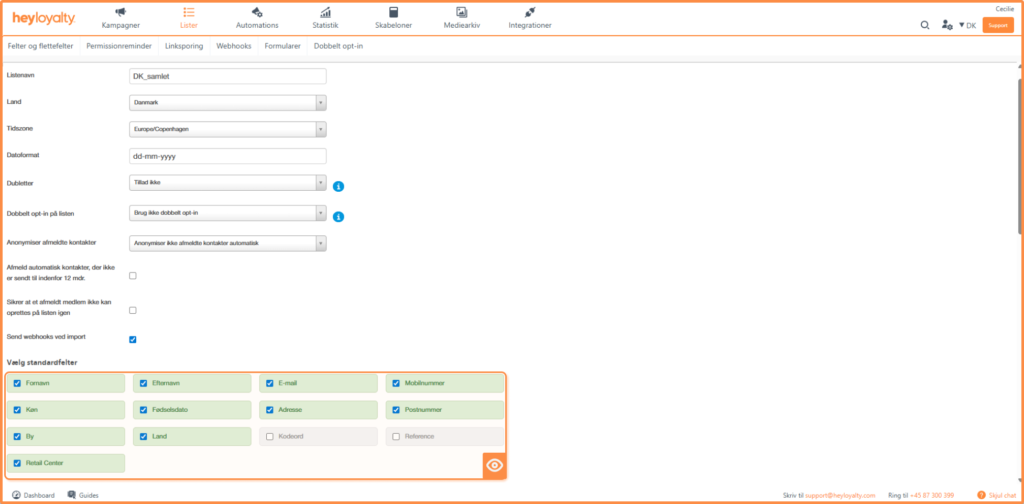
Navipartner’s standard integration retrieves the fields below on the switch:
| Heyloyalty field name | BC field name | Note |
| First Name | member.First Name | Standard field Heyloyalty |
| Last name | member.last name | Standard field Heyloyalty |
| member.e-mail address | Standard field Heyloyalty | |
| Mobile phone number | member.Phone No. | Standard field Heyloyalty |
| Gender | Member.Gender | Default field Heyloyalty. Sent from Navipartner ‘1’ = male, ‘2’ = female |
| Birthday date | Member.birthday | Visiting with children / Visiting without children |
| Address | Member.Address | Standard field Heyloyalty |
| Postal code | Member.Post Code Code | Standard field Heyloyalty |
| By | Member.city | Standard field Heyloyalty |
| Country | Member.HL Country ID | Default field Heyloyalty. Sent as Heyloyalty country code |
| Retail center | Member.HL Store Name | Standard field Heyloyalty |
In addition, customer fields must be created, which can be added at the bottom of the Edit list page. The fields below should be created. We have provided recommended input, but this may vary from customer to customer. See below which fields we recommend:
| Field name | Recommended type | Recommended input |
| Membership code | Single-choice option | Insert the membership codes that exist in BC |
| Medlemsstatus | Single-choice option | Active member, newsletter subscriber, former member (or other options you have in BC) |
| Permission | Multiple-choice option | Notification, newsletter |
| Medlemstype | Text | |
| Item no | Number | |
| Medlemskab aktivt | Yes/No | |
| Medlemskab slutdato | Date | |
| Medlemskab aktiveringsdato | Date |
Permission
Under Permission, we recommend creating the values Notification and Newsletter, so your members can be split into two lists:
- Notifications: All contacts who have made a purchase.
- Newsletter: All contacts who have given consent to receive the newsletter. This includes contacts who signed up via purchases, signup forms, Facebook, Sleeknote, etc.
All members will be created on one list through integration. If you want to separate your permissions, you must set up automation flows to ensure that contacts with Newsletter permission are automatically placed on the Newsletter list. In addition, automation flows must be created to continuously update the member’s permissions on the Newsletter list.
Step 4 – Import members from the website
If you have a newsletter signup form on your website, you need to ensure that contacts who sign up via the form are also created in Heyloyalty.
You can do this by installing the Heyloyalty app on your website. Most of our customers at Navipartner use the Shopify or Magento platforms. You can read how to install the Shopify module here, and the Magento module can be found here.
The list that the module should be linked to is Newsletter.
Once the module has been set up, you also need to create a membership flow that updates the members coming in through the module so they receive the correct newsletter permissions.
Step 3: Heyloyalty webhook
To ensure that changes made directly to members in Heyloyalty are synchronized back to BC, you must create a webhook in Heyloyalty.
Once this is in place, you are ready to set up the webhook. First, generate your webhook URL by following Navipartner’s guide described in the section Procedure in Business Central.
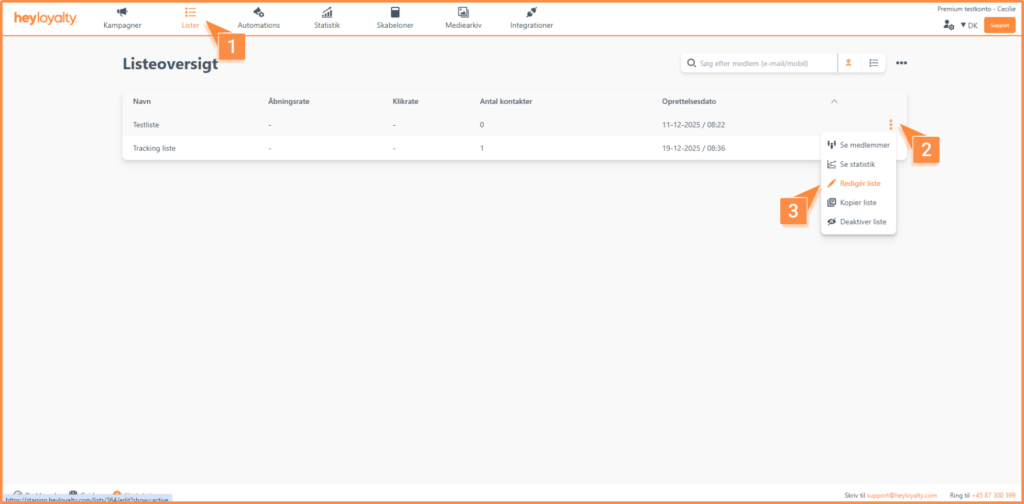
Once the webhook URL has been created, the webhook must be configured in Heyloyalty. The webhook should be set up on the main list where members are initially added. You create the webhook by going to Lists and selecting Edit list:
Then select Webhook > Create a webhook.
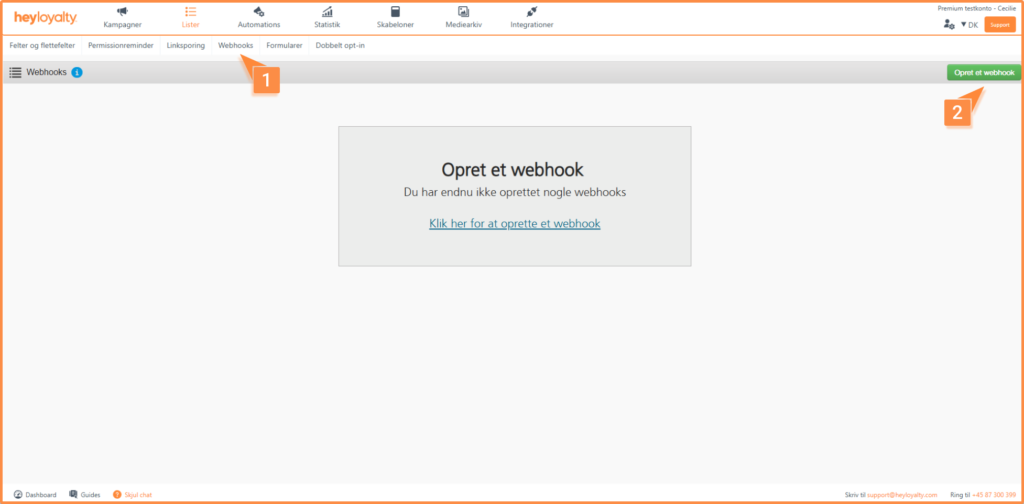
When you click Create a webhook, you will be taken to the webhook settings. Fill in the fields shown on the page. Below is a recommended standard setup:
| Field name | Recommended input |
| URL | Recommended input |
| Contact email | Email address of the person who should receive webhook error |
| Send as raw JSON object | Yes |
| Simplified format | Yes |
| Test payload | Yes |
| Authentication type | OAuth 2.0 |
| Username | The Application ID (client ID) from the Azure AD application details page shown at the end of “Set up Microsoft Entra ID” |
| Password | Client Secret from the Azure AD application details page in BC |
| base URL | https://login.microsoftonline.com/<Your BC tenant ID>/oauth2/v2.0 |
| scopes (optional) | https://api.businesscentral.dynamics.com/.default |
| Tilmeld medlem (e-mail, mobil) | Yes |
| New subscriber (Webpush) | Yes |
| Update subscriber | Yes |
| Unsubscribe subscriber | Yes |
| Spamklage | Yes |
| Click (when a subscriber clicks in an email) | No |
| Opening (when a subscriber opens an email) | No |
| Hard bounces (when a subscriber’s email address hard bounces) | Yes |
| Anonymized subscriber | No |
| Sent (when a subscriber receives an email) | No |
| Send a reply back at transactional emails | No |
Step 4 – Set up tracking integration and product feed
To be able to get purchase data into Heyloyalty and create automation flows and segments based on purchases, you must have created a tracking integration. You can read here how to create a tracking integration.
To ensure that all purchase data from BC is transferred to Heyloyalty, you need to set up custom tracking fields. These are configured under Integrations → List integrations → Edit tracking integration → click the three dots and> select Add custom fields:
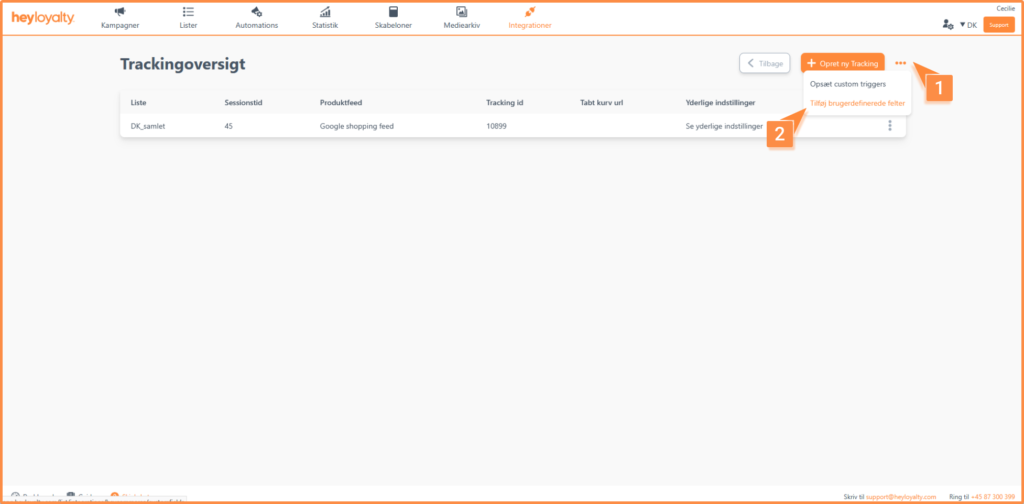
Here you must create a tracking list with fields. If you choose to split your members’ permission, we recommend creating a tracking list for both Newsletter and Notification with the same fields. Add the tracking fields here:
In the standard Navipartner integration, you will get the following data on the purchase event through tracking:
| Heyloyalty field name | BC field name |
| Ticket Holder e-mail | |
| booking_id | m{ExternalTicketNo}_{AdmissionCode} |
| product_id | Ticket Item No. |
| category_id | Ticket Type Code |
| category_name | Ticket Type Description |
| booking_date | Ticket Document Date |
| price | Item Unit Price |
| + admission fields |
Hvis du har dataene i dit produktfeed, vil du også have data på Faktisk dato og klokkeslæt for eventet, event description.
If you need more tracking data than the above, you can use Navipartner’s PTE app. You will need to contact Navipartner for information on what is required to access the app. The app contains the following data fields:
| Field name | Field type |
| scheduled_admission | Date |
| Ticket admission date and Time | Date |
| Ticket valid to time | Date |
| Ticket_scanned | Yes/No |
| Ticket_time_Slot | Date |
| Ticket_type | Text |
| Exhibition name | Text |
If you will have the PTE app installed, the above fields must be created as tracking fields in your tracking integration. The fields are created here:
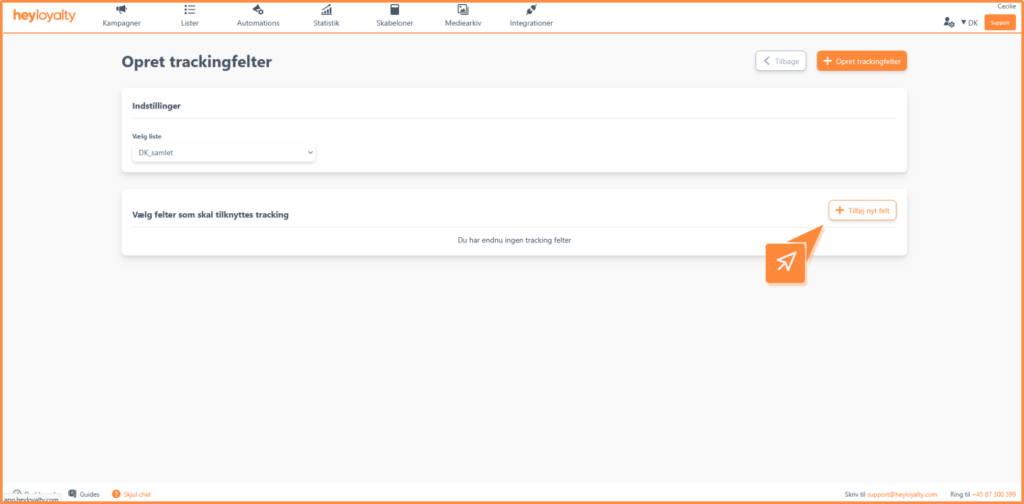
Afterwards, you will be able to see purchase data under the activity feed, which you can find under statistics > activity feed.
Product feed
To insert a product into your campaign, you need to create a product feed. Here you can read how tocreatea product feed.
Kom i gang med Navipartner integrationen
You now have the foundation of your Navipartner integration between BC and Heyloyalty under control. With the integration in place, member and contact data is synchronized across the systems, and your purchases and transactions from the webshop are automatically registered in Heyloyalty’s tracking database.
The integration provides a strong data foundation for working data-driven with your customers — from the first purchase to repeat visits and long-term relationships. When data from Navipartner, BC, and Heyloyalty work together, new opportunities open to automate communication, target campaigns, and create more relevant customer experiences.
The next step is to start using the possibilities in practice
Set up your first automation flows, create segments based on purchase and member data, and customize field mapping and tracking fields to match your business. Often it is the small adjustments that create the most value – for example, a welcome flow, follow-up after purchase or targeted communication to your most engaged customers.
Remember that the integration can evolve as your needs change. You can continuously expand with new data points, adjust to synchronization, and build more advanced automations as you gain deeper insight into your customers’ behavior.

Hvis du mangler information eller hjælp, som du ikke finder her på guide sitet, er du altid velkommen til at kontakte vores support!
support@heyloyalty.com / tlf. 87 300 399